Insights > Newsletters
Newsletters
Boletim de Investigações Corporativas – Outubro 2026
November 10th, 2026

The Corporate Investigations Newsletter aims to provide information on the main media news, trends, cases, and legislation concerning compliance, white-collar crime, competition and international trade matters in Brazil and abroad. This newsletter is for informative purposes only, and should not be used for decision making. Specific legal counseling may be provided by our legal team.
Enjoy reading!
Compliance and Investigations, White-Collar Crime, Competition, and International Trade and Customs teams.

Former tax official at the center of São Paulo State ICMS fraud scheme enters into plea bargain agreement
Former Regional Tax Chief Paulo Sérgio Siqueira Prado, identified by the São Paulo State Public Prosecutor’s Office (MPSP) as a central figure in a corruption scheme involving ICMS (state VAT) refunds, was not charged with the investigated conduct after entering into a cooperation agreement. The former tax inspector was allegedly part of the criminal organization between 2021 and 2025 and received BRL 6.3 million in bribes to steer, expedite, and approve claims that benefited large companies.
According to the criminal charges filed by the MPSP, Paulo Sérgio Siqueira Prado headed the unit responsible for reviewing refund claims and allegedly used his position to assign cases to tax inspectors involved in the scheme, monitor their progress, and centralize within his unit claims that would normally be distributed among different tax offices. His cooperation helped substantiate the charges against a lawyer and three other tax officials, each of whom allegedly played a different role in the scheme.
The MPSP also reported that Prado’s statements were cross-checked against documents, banking and tax records, reports from the Brazilian Council for Financial Activities Control (COAF), text messages, and other evidence.
The case highlights significant integrity risks associated with the use of intermediaries in dealings with public authorities and the exercise of influence over administrative proceedings. It underscores the importance of implementing third-party controls and monitoring relationships involving public officials, especially when an intermediary’s compensation is contingent on a favorable outcome in claims submitted to public authorities.
See more details: G1 news report.
Brazil’s Federal Public Prosecutor’s Office secures convictions in alleged cartel linked to nearly BRL 20 billion in losses to Petrobras
Brazil’s Federal Public Prosecutor’s Office (MPF) announced that two former executives were convicted of cartel conduct in connection with bidding procedures for major Petrobras projects. According to the judgment issued by the 13th Federal Criminal Court of Curitiba, the fraudulent conduct allegedly caused nearly BRL 20 billion in direct losses for the state-owned company. Two other defendants were acquitted for lack of evidence, and the ruling remains subject to appeal.
The investigations indicated that major construction companies formed groups known as “Clube dos 9” and “Clube dos 16” to allocate Petrobras projects among themselves between 1998 and 2014. The cartel predetermined the winning bidders and arranged for higher-priced “cover bids” to be submitted to simulate competition. The prosecution stated that officers of the state-owned company were also allegedly co-opted through bribes to restrict bidding invitations to companies participating in the cartel. The practices reportedly affected at least 87 contracts.
The case highlights the overlap between competition and corruption risks in public procurement, which requires compliance programs to address these matters in an integrated manner. Practices such as price-fixing, market allocation, and improper interactions with public officials may coexist within the same scheme, requiring controls to detect collusion both in dealings with public authorities and in interactions with competitors.
See more details: MPF news report.
Brazil’s Federal Public Prosecutor’s Office discusses integrated strategies to combat corruption linked to organized crime
Brazil’s Federal Prosecution Office (MPF) brought together around 30 federal prosecutors at the 24th National Meeting of its Anti-Corruption Chamber to discuss new strategies for combating corruption and administrative misconduct (improbidade administrativa) linked to organized crime. The MPF noted that the growing sophistication of these practices — including the infiltration of criminal organizations into government structures — has called for greater institutional coordination and new investigative and preventive measures.
The following strategies were highlighted:
- Using intelligence tools and new technologies to analyze and cross-reference data;
- Tracing funds and recovering assets;
- Using negotiated instruments, such as leniency agreements, cooperation agreements, and criminal non-prosecution agreements;
- Cutting off the financial resources of criminal organizations; and
- Implementing prevention and compliance measures as part of the institutional response to these developments.
The discussion highlights the growing convergence of anti-corruption, anti-money laundering (AML), and organized crime agendas. For companies, this landscape emphasizes the importance of an integrated compliance approach that considers not only traditional corruption risks in interactions with public officials but also the source and destination of funds, third-party arrangements, and potential links to criminal organizations.
See more details: MPF news report.
New methodology targets forfeiture of assets linked to PCC and Comando Vermelho
Brazil’s Ministry of Justice and Public Security (MJSP) announced the filing of civil asset forfeiture actions under the Raul Jungmann Law[1] targeting the assets linked to ultra-violent criminal organizations. The actions relied on a novel methodology that turns asset information from various public agencies into input for asset recovery and cut off the financial resources of these organizations.
The methodology was developed by the National Secretariat of Justice through the Strategic Crime Laboratory (LabCrim/DRCI). It identifies high-value properties registered in the names of individuals whose financial means do not justify such holdings and who have ties to criminal factions or militias. The model combines cross-referencing and data enrichment from Brazil’s Federal Revenue Service, the National Council of Justice (CNJ), the Office of the Comptroller-General (CGU), and other relevant authorities. The aim is to conduct more in-depth asset investigations and support the Federal Attorney-General’s Office (AGU) in filing forfeiture actions.
This initiative is significant for compliance and anti-money-laundering (AML) efforts, as it highlights the increasingly sophisticated tools that authorities are using to identify assets linked to organized crime. Cross-referencing asset information, analyzing economic inconsistencies, and identifying indirect connections underscore, for the private sector as well, the importance of adopting effective mechanisms to identify beneficial owners, conduct due diligence, and monitor higher-risk counterparties and transactions.
See more details: MJSP news report.
[1] Law No. 15,358/2026

Brazil establishes rules for the early sale of assets seized in criminal cases
Brazil’s National Council of Justice (CNJ) has published Provision No. 257/2026, which establishes a national procedure for the early sale of assets seized by the Federal Police in relation to criminal proceedings. The measure aims to prevent these assets from remaining in public storage facilities for extended periods, reducing depreciation and maintenance costs while legal proceedings run their course.
The procedure covers assets in Federal Police custody that have been listed by regional superintendencies. If the court that ordered the seizure does not object within 90 days the provision’s publication, the National Secretariat for Drug Policy and Asset Management (SENAD) may sell the listed assets, preferably through an online auction.
The parties involved in the proceedings, the Federal Public Prosecutor’s Office, and interested third parties have 20 days from the publication of the provision to request that the court maintain the seizure, order the return of an asset, or remove it from the list of assets to be sold. The courts must rule on these requests within ten days. If the objection to the sale is upheld, the decision must be communicated to SENAD to prevent the asset from being included in the sale process.
Provision No. 257/2026 also stipulates that the proceeds from early sales will be deposited in accounts linked to the corresponding legal proceedings. Therefore, an early sale does not constitute a permanent loss of the assets, and the allocation of proceeds will depend on the outcome of the case and applicable court rulings.
See more details: Corregedoria Nacional de Justiça estabelece regras para agilizar venda de bens apreendidos pela PF
Brazil spearheads negotiations on international protocol to address environmental crimes
Brazil led the push to approve a resolution launching negotiations on a protocol against transnational crimes affecting the environment. The initiative seeks the adoption of an additional protocol to the United Nations Convention against Transnational Organized Crime (the Palermo Convention). The resolution was approved at the 13th Conference of the Parties to the Palermo Convention (COP13), held in Vienna in October.
The future protocol is expected to cover three categories of conduct:
- Trafficking in wild animals and plants, including timber and forest products;
- Illegal extraction and trafficking of minerals and precious metals;
- Illicit waste trafficking.
The new protocol should establish international cooperation mechanisms to prevent and investigate conduct covered by the initiative, as well as to strengthen the prosecution of perpetrator and hold them accountable.
The resolution calls for the establishment of an ad hoc committee, which will hold four negotiating sessions to draft the new international instrument. A draft text is expected to be submitted for consideration by the States Parties at COP14, scheduled for 2028.
See more details: Brasil lidera avanço internacional contra crimes ambientais
“ECA Digital”: Brazil’s Federal Police sets rules for company registration to submit notifications of crimes and violations against children and adolescents
The Brazilian Federal Police has established rules[1] for IT product and service providers to register with the Nidus System, a platform designed by providers to submit notifications of crimes and violations against children and adolescents identified on digital services. The regulation also provides for the accreditation of individuals designated by suppliers to submit reports to the Federal Police.
Registration is mandatory for websites and apps in Brazil aimed at, or likely to be accessed by, children and adolescents if their products or services pose a risk of online sexual violence. The requirement also applies to providers of pornographic content, escort services, and dating or matchmaking services of a sexual nature, regardless of where they are based or where their services are developed or operated.
Providers subject to mandatory registration have 60 days to submit the completed form, from the publication of the ordinance (October 20, 2026). The Brazilian Federal Police also recommends that providers in the mandatory categories register even if they have not identified any incidents, should they perceive a risk of such incidents occurring.
The measure is the first stage in implementing the notification process established by Ministry of Justice and Public Security (MJSP) Ordinance No. 1,312/2026, under Law No. 15,211/2025 (ECA Digital) and Decree No. 12,880/2026. The second stage, which concerns the report-submission procedure, will be subject to further regulation by the Federal Police.
See more details: Empresas têm 60 dias para fazer cadastro no Sistema Nidus da Polícia Federal
[1] Federal Police Director-General Ordinance (Portaria DG/PF) No. 19,107/2026.
Brazil’s Supreme Court allows state police to hold mediation and conciliation hearings for minor offenses
Brazil’s Federal Supreme Court ruled unanimously that the São Paulo Civil Police may hold mediation and conciliation hearings in cases involving minor criminal offenses.
The ruling was handed down in Direct Action for the Declaration of Unconstitutionality No. 6,251, filed by the National Association of Members of the Federal Public Prosecutor’s Office (CONAMP) against the decree that regulates the Special Criminal Units (Necrims) of the São Paulo State Civil Police.[1]
Among other arguments, CONAMP contended that the decree encroached on the powers of the Judiciary and the Public Prosecutor’s Office and established rules of criminal procedure, a matter reserved to federal legislation.
In following the opinion of Justice André Mendonça, rapporteur for the case, the Court found that the decree governs the internal organization and administrative procedures of the Civil Police, without establishing rules of criminal procedure or amending the provisions of , which governs the special civil and criminal courts and establishes conciliation mechanisms for minor offenses. The Court also emphasized that hearings held at police stations do not replace the role of the Judiciary or the Prosecutor’s Office. Any agreements must be submitted to the courts and will have legal effect only once the Prosecutor’s Office has issued an opinion and the court has ratified them.
See more details: STF valida conciliação em crimes de menor potencial ofensivo pela Polícia Civil de São Paulo
[1] Ruling on Direct Action for the Declaration of Unconstitutionality No. 6,251, filed against São Paulo State Decree No. 61,974/2016

CADE approves American Airlines’ investment in Azul, subject to agreement containing competition safeguards
The Tribunal of Brazil’s Administrative Council for Economic Defense (CADE) approved American Airlines’ acquisition of a nearly 8% minority stake in the capital stock of Brazilian airline Azul S.A., subject to the execution and full compliance with a merger control agreement.
The USD 100 million investment is part of Azul’s financial restructuring under Chapter 11 of the U.S. Bankruptcy Code. The transaction drew particular attention for involving competitors that operate air routes between Brazil and the United States and for strengthening corporate and commercial ties within the sector.
The transaction does not grant the investor veto power over strategic decisions or the unilateral competence to define Azul’s commercial policy. Nonetheless, Reporting Commissioner Camila Alves flagged a risk of access to prospective, non-public information. To mitigate this risk, the merger control agreement limits the sharing of competitively sensitive information and aims to preserve the companies’ competitive independence. The agreement also mandates the monitoring of American Airlines’ future acquisitions of stakes in airlines operating regular flights between Brazil and the United States. Finally, it requires notification of any changes to American Airlines’ voting rights, powers of influence, and representation in Azul’s governance.
See more details: Cade aprova aquisição de participação minoritária da American Airlines na Azul mediante celebração de acordo
CADE sustains dismissal of soy moratorium case and imposes a fine on Aprosoja/MT
CADE’s Tribunal denied the motion for clarification filed by the Aprosoja/MT (Association of Soybean and Corn Producers of the State of Mato Grosso) and sustained the immediate dismissal of Administrative Proceeding No. 08700.005853/2024-38, which concerned the Soy Moratorium. The termination stemmed from an express and binding ruling by the Brazilian Federal Supreme Court, issued in the joint judgment of Direct Actions for the Declaration of Unconstitutionality Nos. 7,774 and 7,775.
According to Reporting Commissioner José Levi, the motions for clarification did not demonstrate any omission, ambiguity, or contradiction that would justify granting them. Commissioner Levi also noted that CADE’s Tribunal had already unanimously denied motions for clarification filed by Aprosoja/MT, on the same grounds, in 14 appeals linked to the administrative proceeding.
The Tribunal found that the new motions were clearly dilatory and frivolous, as they represented a systematic attempt—through unfounded motions—to avoid complying with the Federal Supreme Court’s order. As a result, the Tribunal imposed a procedural fine of BRL 250,000 on Aprosoja/MT, which could increase if the conduct were repeated.
See more details: Cade mantém extinção de processo envolvendo a moratória da soja
CADE dismisses consultation on mandatory filing for real estate acquisitions
CADE’s Tribunal dismissed the consultation filed by the Brazilian Association of Real Estate Developers (ABRAINC) into whether developers must give prior notice when acquiring land, buildings, and other real estate for project development.
ABRAINC inquired whether these acquisitions could be deemed a purchase of a “part of a company” under Article 90, item II, of Law No. 12,529/2011, which would render them mergers subject to mandatory notification. The entity argued that there was inconsistency in the General Superintendence’s decisions, leading to legal uncertainty and regulatory costs. ABRAINC contended that notification should be mandatory only in exceptional cases involving properties that are scarce, irreplaceable, and significant for the entry of competitors due to regulatory restrictions.
According to the Tribunal, the merits of the request were not reviewed because it raised a hypothetical question without identifying a specific transaction or material scenario that would allow CADE to reach a conclusion. Rapporteur Commissioner José Levi pointed out that meeting the formal requirements of Article 3 of CADE Resolution No. 12/2015 does not, by itself, guarantee that the merits of a consultation will be reviewed. The rapporteur further clarified that consultations are not intended for general, abstract legal theories that are disconnected from identified facts. Given the absence of a specific transaction, the request was denied under Article 4, item IV, of the resolution.
See more details: Consulta da ABRAINC sobre compra de imóveis é indeferida pelo Cade

Brazil launches public consultation on Mercosur-Indonesia agreement
The Brazilian Secretariat of Foreign Trade (SECEX) launched a public consultation to help define Brazil’s priorities and positions in negotiations for the Preferential Trade Agreement between MERCOSUR and Indonesia.
The consultation seeks technical and sectoral contributions to assess the potential effects of an agreement with Indonesia and to establish a negotiating stance grounded in evidence and dialogue with society. The contributions will help map each sector’s interests and obstacles.
Who should contribute?
- Brazilian exporters and potential exporters: companies that already export or may start exporting to Indonesia, with an interest in reducing tariffs and other barriers to accessing the Indonesian market.
- Brazilian importers: companies that import or are interested in importing products from Indonesia, which may benefit from improved market access conditions and greater facilitation of trade flows.
- Domestic producers: companies and sectors with defensive interests or concerns regarding increased imports originating from Indonesia, which may provide information on the potential impacts of trade liberalization on the Brazilian market.
Additional issues that may affect stakeholders include trade in services, investment, intellectual property, government procurement, trade remedies and safeguards, trade facilitation and customs cooperation, regulatory practices, competition, and sustainable development, including environmental, social, and labor-related issues.
How to participate
Interested parties must submit their contributions by December 20, 2026, through the Brasil Participativo platform.
See more details in SECEX Circular No. 105/2026.
Brazilian beef exports to China face 67% tariff on volumes exceeding the quota
A partir de 1º de outubro de 2026, as exportações brasileiras de carne bovina para a China passaram a estar sujeitas à tarifa total de 67%, após o Brasil atingir a cota anual de 1,106 milhão de toneladas estabelecida pelo governo chinês como medida de proteção ao mercado interno. A tarifa é composta pela alíquota regular de 12% mais uma sobretaxa de 55%.
A China é o principal destino da carne bovina brasileira:
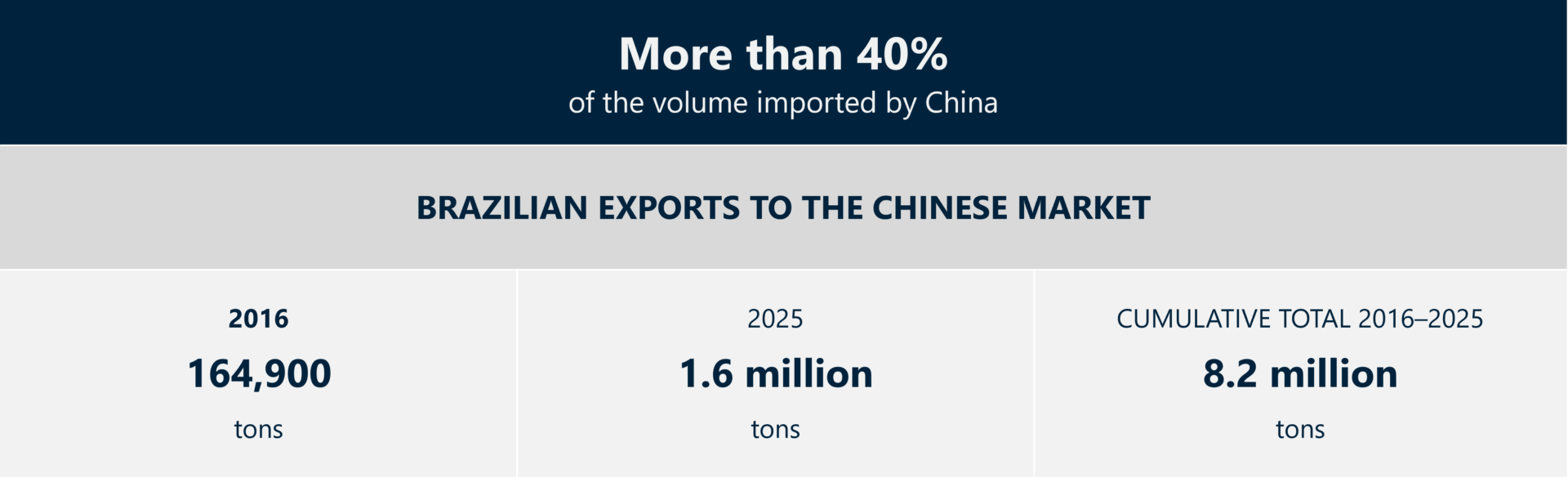
Para 2027, a cota será elevada para 1,128 milhão de toneladas. A Associação Brasileira das Indústrias Exportadoras de Carnes (Abiec) discute a antecipação dos abates para outubro e dos embarques para novembro, de modo que os produtos cheguem à China em janeiro. A Abiec também avalia a divisão da cota entre os frigoríficos para distribuir os embarques ao longo do ano. Representantes do setor estimam, contudo, que o novo limite poderá ser atingido já em março ou abril de 2027.
Entenda mais detalhes: nota da Agência Brasil.
New notifications of the initiation of safeguard investigations
Em outubro de 2026, foram notificadas à Organização Mundial do Comércio (OMC) a abertura das seguintes investigações de salvaguarda:
- Madagascar: produtos de confeitaria à base de açúcar, bem como de produtos de confeitaria à base de chocolate e cacau
- Filipinas: carne suína
- Zimbábue: determinados produtos de massas alimentícias
A eventual aplicação de salvaguardas pode afetar as exportações brasileiras dos produtos investigados para esses mercados.
Related Partners










Related Areas
Compliance and Investigations White-Collar Crime Competition International Trade and Customs
Share