Insights > Client Alerts
Client Alerts
Complementary Law No. 236/2026 published: Comprehensive reform of the National Tax Code and new rules on consensual settlements, penalties, and administrative tax proceedings
September 23rd, 2026

Complementary Law No. 236/2026 has been in force since September 4, 2026. It amends Brazil’s National Tax Code (“CTN”) to establish general rules on dispute resolution, penalties, consensual settlements, and administrative proceedings in tax and customs matters.
Consensual Tax Dispute Resolution: Arbitration, Mediation, and Settlement
Complementary Law No. 236/2026 now establishes, within the CTN, mechanisms for the consensual or alternative resolution of tax and customs disputes.
- Special tax and customs arbitration (Article 171-A): A special law will authorize the mechanism. The arbitration award is binding and has the same effects as a court decision. If it is favorable to the taxpayer and becomes final and unappealable, it will extinguish the tax credit (Article 156, XII).
- Tax and customs mediation (Article 171-B): This will be conducted by a third party without decision-making powers, who is selected or accepted by the parties. The agreement will suspend the enforceability of the tax liability for its duration (Article 151, IX), and its fulfillment will extinguish the tax liability (Article 156, XIII).
- Tax settlement: A settlement proposal accepted by the tax administration suspends the enforceability of the tax liability (Article 151, VIII).
- Tax neutrality (Article 171-C): Tax and customs settlements, mediation, and special arbitration do not constitute a waiver of revenue for the purposes of the Fiscal Responsibility Law.
Penalties and reductions
- Fine limits (Article 113-A): Penalties must adhere to the principles of reasonableness and proportionality. The fine may not exceed 75% of the assessed tax or the affected tax credit. The limit is 100% when the intentional commission of fraud, tax evasion, or collusion is established, and 150% in the event of a repeat offense. These limits do not apply to individual fines unrelated to the amount of credit or tax.
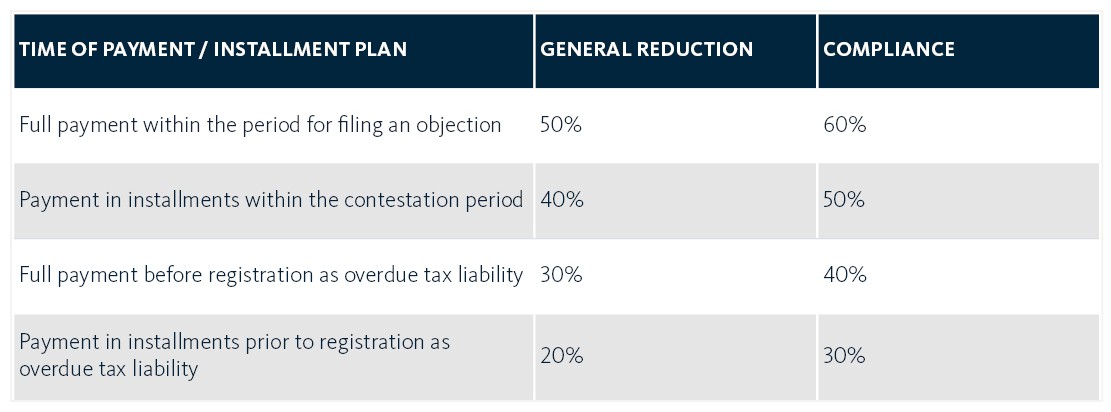
- Penalty reductions (Article 142, §§ 5 and 10): These may be granted, in accordance with local laws, based on the timing of payment or installment arrangements, with specific percentage reductions available to participants in compliance programs.
- Voluntary disclosure (Article 138): Excludes liability, including for late-payment penalties, when accompanied, if applicable, by payment of the tax due and interest for late payment, or by deposit of the assessed amount.
- Habitual tax debtor (devedor contumaz) (Article 142, § 6): Is not entitled to any gradation, reduction, or waiver of the penalty.
Peremption, Statute of Limitations, and Tax Overpayments
- Peremption (Article 150, paragraphs 5 and 6): The CTN now expressly provides that, in cases of intent, fraud, or simulation, the rule of Article 173, item I, of the CTN applies for the purpose of calculating the peremptive period. Furthermore, the understanding has been formalized that, in the case of partial payment of the tax subject to homologation, the limitation period begins to run from the occurrence of the triggering event.
- Preliminary injunction or provisional relief (Article 161, Paragraph 3): The filing of a lawsuit in which a preliminary injunction or provisional relief has been granted suspends the accrual of the late payment fine from the time the measure is granted until 30 days after publication of the decision that determines the tax to be due.
- Tax overpayments (Articles 165-A and 168, Paragraphs 2 and 3): Tax overpayments will be adjusted using the same indices applicable to the tax credits of the Federal Government, the states, the Federal District, and the municipalities, as the case may be. The period for the recovery of tax overpayments also applies to the administrative recognition before the tax administration and, in this case, is valid from the certification of the final and unappealable decision.
- Interruption of the Statute of Limitations (Article 174, Paragraph 1): The new grounds include:
- The extrajudicial protest of the Certificate of Overdue Tax Liability (Certidão de Dívida Ativa – “CDA”) or the judicial protest;
- The initiation of tax mediation;
- The initiation of special tax and customs arbitration, with retroactive effect to the date of the request;
- A judgment terminating the tax enforcement proceeding due to the inability to locate the debtor or assets subject to seizure, provided that the intercurrent statute of limitations has not yet begun;
- The reporting of the claim in the bankruptcy or out-of-court liquidation of the taxpayer, with suspension of the limitation period until the conclusion of the proceedings; and
- The initial act of extrajudicial tax enforcement.
Administrative tax proceedings
Complementary Law No. 236/2026 adds Articles 208-A to 208-J to the CTN, establishing general rules for administrative tax proceedings (“PAF”) at the federal, state, Federal District, and municipal levels.
- Two-tier jurisdiction: Federative entities with more than 100,000 resident inhabitants must ensure this in administrative tax litigation, in accordance with specific legislation.
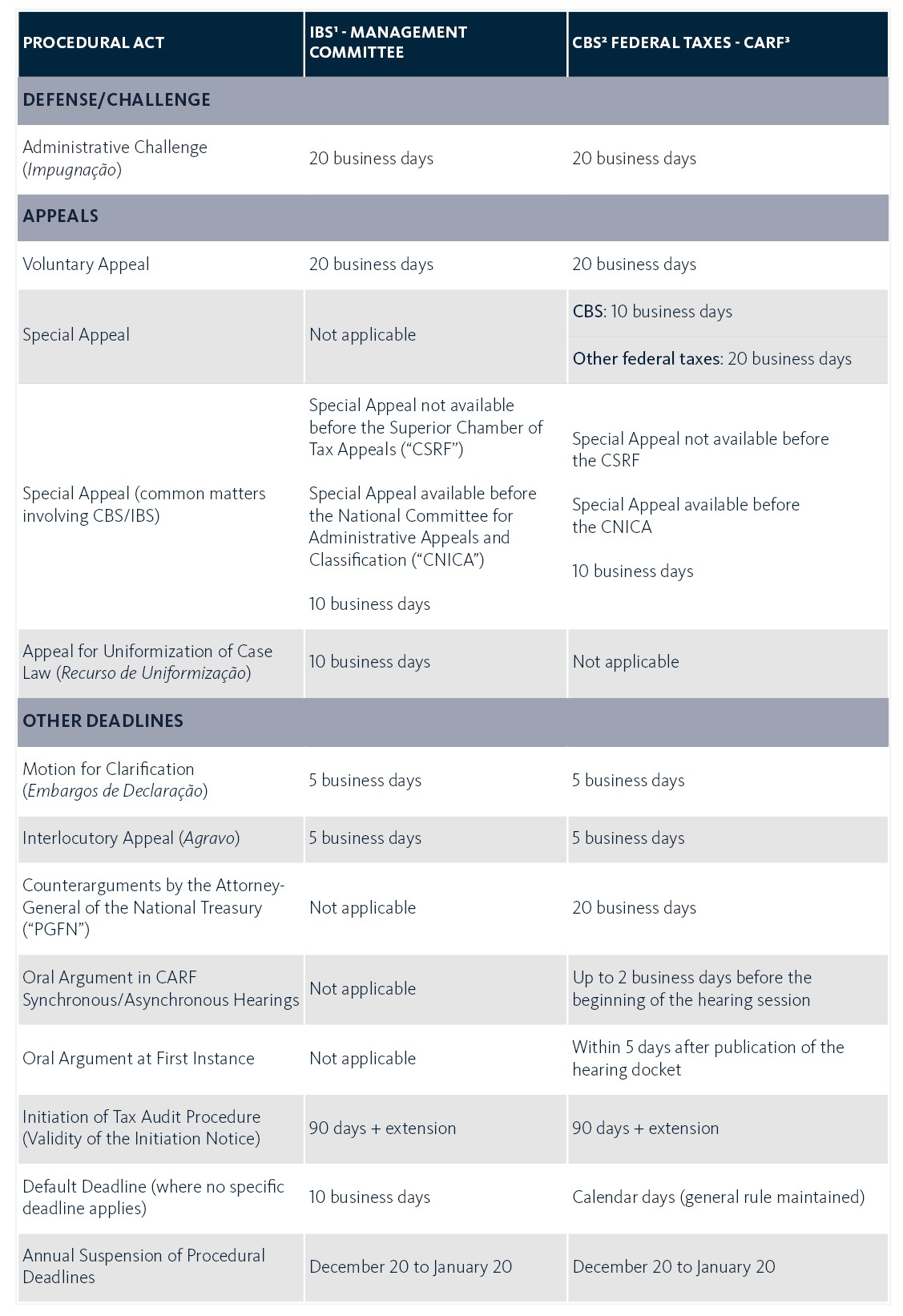
- Procedural deadlines: Challenges, voluntary appeals, and special appeals will have a deadline of 20 business days. Motions for clarification must be filed within 5 business days. The running of the time limits is suspended between December 20 and January 20. For reference, below is a consolidated table of the general time limits currently in force for tax litigation:
- Administrative decisions: A hierarchical appeal is not admissible against a final decision rendered in a tax administrative proceeding that is favorable to the taxpayer.
- Binding effect: Binding pronouncements from the Federal Supreme Court (“STF”) and the Superior Court of Justice (“STJ”); decisions issued under the general repercussion system or in repetitive appeals; decisions rendered in concentrated constitutional review; Senate resolutions; and administrative precedents are binding on tax administrative proceedings.
- Tax assessment notice (Auto de Infração) (Article 208-B): This must include, among other elements, the identification of the assessed taxpayer, a clear description of the facts, the legal basis, the penalty imposed, and the determination of the tax liability.
- Procedural guarantees: The requirement of a bond or deposit guarantee for the filing of challenges, appeals, or requests is prohibited (Article 151, paragraph 2).
Other relevant changes
- Legal criteria for assessment (Article 146): A modification made ex officio or as a result of an administrative or judicial decision – or an arbitral award rendered within the scope of special tax and customs arbitration – may only be effected (regarding the same taxpayer) with respect to a triggering event that occurred after its introduction.
- Nullities and legality (Article 208-H): The tax administration must annul its own acts that are tainted by a legal defect. Among others, the following are null and void: acts and instruments drawn up by an incompetent authority, body, or official; assessments lacking a legal basis; and notices issued without adhering to legal requirements.
- Electronic Tax Domicile (Article 127-A): Notices of procedural acts may be served through the Electronic Tax Domicile (Domicílio Tributário Eletrônico – “DTE”), including to attorneys-in-fact.
- Binding precedents (Article 194-A): Final decisions of the STF and the STJ that are binding in the judicial sphere are also binding on the tax administration, which must give public notice thereof within 90 business days.
Tax compliance (Article 194, paragraphs 2 and 3): The tax administration must prioritize preventive methods to enable self-regularization before issuing a tax assessment notice and establish programs aimed at preventing conflicts. - Tax audit (Article 196, paragraphs 2 to 4): The initiation of the tax audit procedure must be formalized in a document that identifies the responsible authorities, the taxpayer, the subject matter and period of the audit, the necessary documents, and the duration.
- Registered tax liability (Article 201, paragraphs 2 and 3): The taxpayer has the right – and the Public Treasury has the obligation – to ensure the legality of the registration, specifically regarding the certainty, liquidity, and enforceability of the tax liability. As a general rule, the information required for registration and collection must be submitted within 90 business days from the date the tax becomes due, subject to the legal provisions allowing for an extension or reduction of this period.
- Presidential vetoes: Provisions involving, among other topics, individual fines, joint and several liability, third-party liability, recidivism, statute of limitations, tax certificates, nullities in the PAF, and the repeal of Article 44, paragraph 2, of Law No. 9,430/1996 were vetoed.
Demarest’s Tax team remains available to provide further clarification.
Related Partners




















Related Areas
Share